- AI Strategist News
- Posts
- AI Weekly News Update: 12/29/2025
AI Weekly News Update: 12/29/2025
AI Strategist News: Navigating the transformative world of AI for your business

Layla Hecker
December 29, 2025

Table of Contents
This Week

Bottom Line Up Front
Groq has signed a non-exclusive licensing agreement with NVIDIA, allowing NVIDIA to access Groq's AI inference technology.
As part of the agreement, Groq's president Sunny Madra and CEO Jonathan Ross will move to NVIDIA, with Simon Edwards succeeding Ross as Groq's CEO.
NVIDIA has agreed to acquire Groq's assets for approximately $20 billion in cash, excluding Groq's cloud business, which will continue to operate without interruption.

Bottom Line Up Front
OpenAI CEO Sam Altman believes that by 2030, AI models will be capable of doing things that humans cannot, with GPT5 already being smarter than many people.
The AI advances in 2025 have set the world on a path of explosive growth, with unprecedented surge in productivity and practical applications advancing at a rapid pace, according to The Economist and Idan Feingold.
The AI market is expected to continue growing, with estimates predicting over $7 trillion spent on AI by the end of the decade, and 2026 is anticipated to bring extreme reactions, including potential economic revival, financial bust, or social backlash.
Business Use Cases

Why is this important
The increasing complexity of digital commerce is creating more opportunities for fraud, with features like one-click checkouts and subscription bundles making it easier for bad actors to exploit the system.
According to Adam Hiatt, Vice President of Fraud Strategy at Spreedly, the proliferation of AI-driven tools is making it easier for professionalized fraudsters to operate, and fraud prevention must mature to keep up.
To effectively prevent fraud, companies need to adopt a unified, contextual risk response that can operate in real-time, using tools like machine learning models and data synthesis to synthesize signals and automate responses with precision.
Bottom Line Up Front
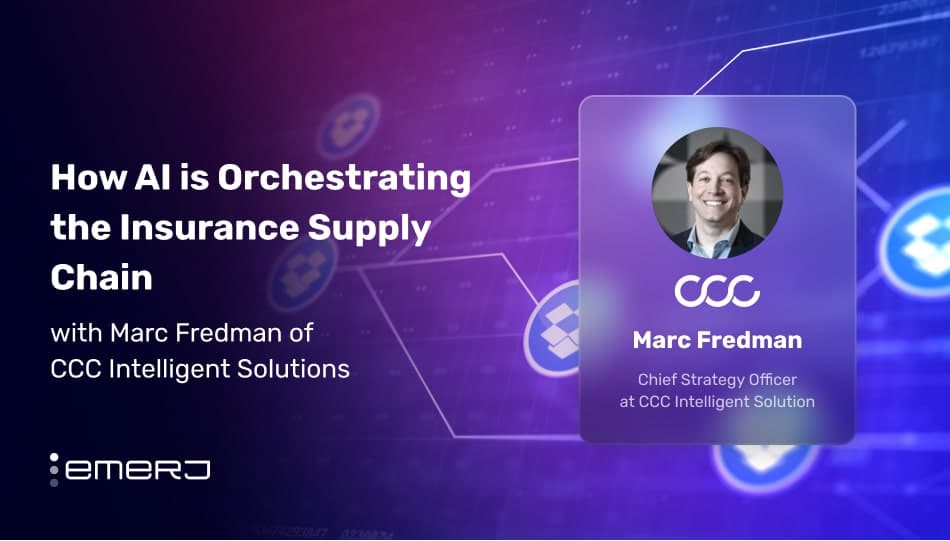
Marc Fredman, Chief Strategy Officer at CCC Intelligent Solutions, discusses how AI is transforming the insurance supply chain, particularly in auto insurance claims.
He highlights the need for ecosystem-wide transformation, where insurers act as orchestrators of the entire claims ecosystem, aligning stakeholders to deliver accurate decisions, faster cycle times, and better customer outcomes.
Fredman also emphasizes the importance of addressing the talent shortage in the claims and repair ecosystem by integrating AI into high-skill roles to bridge the growing talent gap and support retiring experts.

Bottom Line Up Front
Europe's healthcare systems increasingly adopted AI in 2025 to predict disease, speed diagnosis, and reduce administrative workloads, with countries like Finland, Estonia, and Spain leading the way.
AI tools were used to train staff, analyze medical data, and detect illnesses earlier, with researchers advancing models to forecast conditions like heart disease, diabetes, and certain cancers.
Despite benefits, experts warned of risks, including the potential for extremists to exploit AI and the limitations of chatbots in handling mental health support, prompting calls for stronger safeguards and responsible deployment.
Bottom Line Up Front
Four tech professionals, including Patrick Leung, Sophia Sun, Mostofa Adib Shakib, and Devi Parikh, shared the same advice for breaking into AI: gain real-world experience with AI technology.
They recommend "getting your hands dirty" by playing around with AI, building projects, and applying AI to real-world problems to demonstrate proficiency.
This hands-on experience can be gained through work projects, personal projects, or even contract work, and is considered more valuable than just having a degree or theoretical knowledge.
PRESENTED BY HeyReach
10x your LinkedIn outbound. Unlimited senders, one fixed cost
For agencies, sales teams, and GTM experts who want to automate LinkedIn outreach, reach 1000+ leads weekly, and book more meetings.

Things to Pay Attention to

Bottom Line Up Front
The world is not prepared for an AI emergency, which could cause widespread disruption to critical infrastructure and services, and potentially lead to social panic and a breakdown in trust.
Governments and companies have started to build guardrails to manage AI risks, but a plan for preventing social panic and a breakdown in trust, diplomacy, and basic communication is still missing.
The United Nations is proposed as the overseer of AI emergency preparedness initiatives, which should include a shared definition of an AI emergency, a practical playbook, and crisis communication protocols to ensure a coordinated response to an AI emergency.

Bottom Line Up Front
HGP Intelligent Energy has proposed using nuclear reactors from retired US Navy aircraft carriers and submarines to power an AI data center at Oak Ridge National Laboratory in Tennessee.
The plan involves repurposing two former US Navy reactors to provide 450-520 megawatts of constant power, with an estimated cost of $1 million to $4 million per megawatt.
The project, expected to cost $1.8 billion to $2.1 billion, aims to provide decades of stable, carbon-free baseload power, but raises concerns around transportation, refitting, nuclear waste, and long-term safety and security.

Bottom Line Up Front
Modem's Dream Recorder allows users to replay their dreams as short animated videos.
Filip Budny's WaterSense buoy uses AI to monitor water quality in rivers and lakes, providing real-time data to fight pollution.
1X's Neo Gamma robot is a robo housekeeper that uses a multitasking AI model to understand voice commands and control motor functions.
MIT's Biru Cao and Yiqing Wang developed FOODres.AI, an AI-powered 3D printer that turns food waste into printing filament.
LeafyPod is a self-watering smart planter with an AI-powered watering system that adapts to the needs of the plant.
Kateryna Lopatiuk and Herman Mitish's Circularity on the Edge uses AI to identify salvageable materials in rubble for reconstruction efforts.
Even Realities' Even G2 smart glasses use AI and eliminate the outward-facing camera for improved privacy.
Max Park's Prompting Nowhere is a treadle-powered AI that visualizes the hidden labor behind technology by making output contingent on manual effort.
Your opinion matters! Your feedback helps me create better emails for you! Loved it 😍 😍 😍 Ok 🫤 Horrible 🤢 Got more feedback or just want to get in touch? Reply to this email and we’ll get back to you. _________________________________________________________________ Thanks for reading. Until next time! Layla and AI Strategist News Team |
|